


In conversations with our customers, especially those online merchants who have just ventured into the business world, we notice that there is a lot of ignorance and misunderstanding about parities (or Incoterms) that they must determine, before they import the goods from suppliers.
As a result, this often means problems, unexpected costs for the importer and complications with complaints due to damaged goods, if the trader trusts the supplier too much and leaves the choice to him, without being aware of the consequences. Those who are just starting to import from China and do not know their suppliers (from Alibaba, Aliexpress, etc.) are particularly exposed here.
Therefore, this time we will present you in more detail and on practical examples the 4 most common parities when importing goods, be it by air or sea transport.
At the end of the article, we will tell you about a hidden problem, which is rarely talked about, but which happens to an increasing number of Slovenian traders when importing from China, and for some it even completely unexpectedly threatens the business even before the start of sales.
Kaj so Incoterms oz. kaj je pariteta?

The image above should serve as a visual representation of what you can expect when choosing a particular parity. In short, this means that it is cheapest for you to order the goods with EXW parity, but this means that you will organize the collection of the goods from the supplier, whole transport, customs clearance and final delivery to your address in Slovenia entirely by yourself (and in case of problems on this paths also be responsible in search of the culprit).
On the other hand, the DDP parity is the most expensivefor the client, in which the supplier undertakes to cover the entire transport, including all customs and other fees and delivery to the final address, by himself - that is, the cost that you pay in advance is also the final cost for everything. However, there is a certain problem here as well, which has been exploited/abused by many (mainly Chinese) suppliers lately - more on this at the end of the article.

Incoterms, short for International Commercial Terms, is a set of globally recognized trade terms published by the International Chamber of Commerce (ICC). These terms are used to define the responsibilities and obligations of buyers and sellers in international trade transactions. They help reduce misunderstandings and disputes between parties by clarifying the allocation of costs, risks and responsibilities. In this guide, we will explain four important incoterms: EXW, DAP, DDP and FOB.
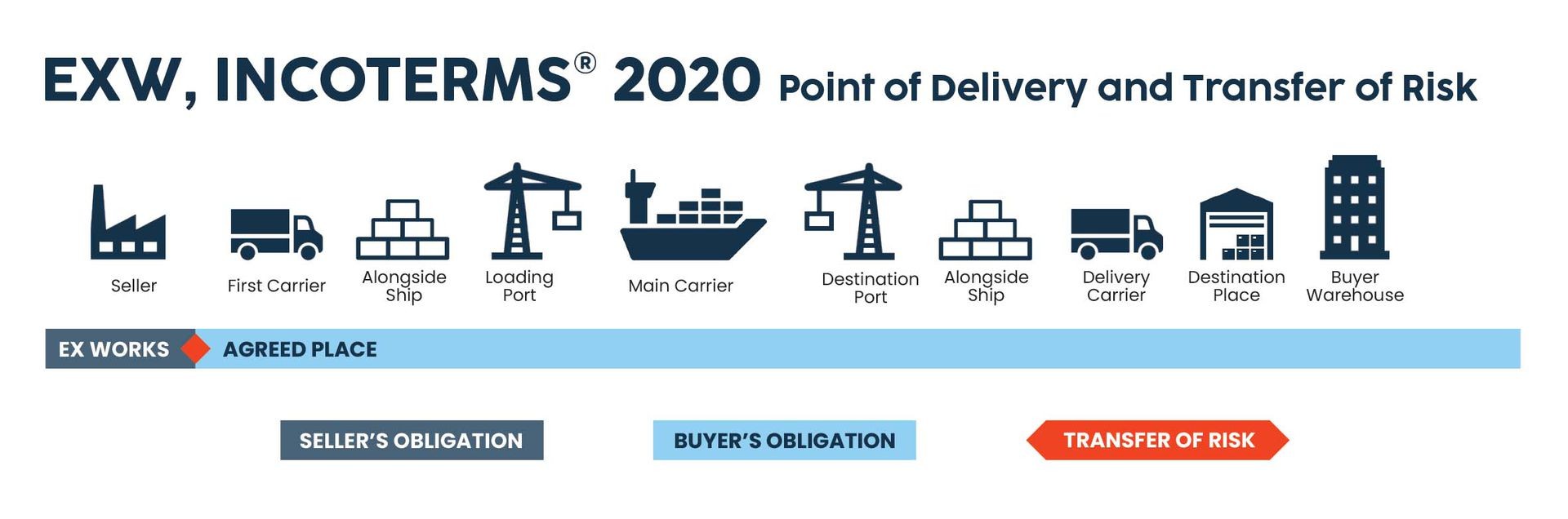
EXW (Ex works)
Ex Works is the incoterm that imposes the least responsibility on the seller.According to EXW, the seller is obliged to make the goods available only on his premises or at another specified location. The buyer is responsible for organizing and covering all costs related to the transportation, loading, unloading, customs clearance and insurance of the goods from the seller's location to the final destination.
In more detail, EXW means:
-
- The seller must prepare the goods for collection and inform the buyer when they are ready.
-
- The buyer must organize and pay for transportation, loading and all other related costs.
-
- The buyer bears all risks during transport and is responsible for obtaining the necessary permits, licenses and documentation required for export and import.
When to use EXW parity?
In practice, EXW parity is used when:
-
- we know the supplier better and have been working with him for a long time, because we have to trust him that he has packed the right items, enough items and that the items are not damaged even before delivery. Namely, as long as we receive broken/damaged items, proving the culprit is the most difficult at EXW parity (the carrier will blame the supplier, and the supplier will tell you that they were definitely damaged during transport, in the absence of evidence, you will probably end up paying for the damage). If you do not know the supplier, he may also decide that you are unimportant to him as a customer and simply pack inferior or already damaged items for you - this has already happened even to the largest Slovenian retailers.
-
- your price for EXW delivery is much better than the price offered by the supplier and it is worth taking this risk. How much of a price difference the trader is willing to take such a risk is, of course, a matter for the individual and often also a matter of the value of the shipment. Simply determine how much your time is worth to deal with this shipment and the associated risks.
-
- before deciding on EXW parity, it is necessary to inquire about the difference in price with DAP or DDP parity and to check whether it is more convenient for you to order transport from a Slovenian agent (e.g. DHL Slovenia) or leave it to the supplier (DHL China). The price differences can be minimal or really big.
Bolj primerno za izkušene uvoznike
-
- we are skilled and familiar with the customs clearance procedures, we have all the necessary documentation for the item and we at least roughly know how much the costs of transport + customs clearance + any additional surcharges will be. Most often, this process is then done with the help of a carrier, e.g. DHL Slovenia, who represent you in the customs clearance process, and you just provide the necessary documentation (invoice for the goods, proof of payment, any additional documentation if necessary for the type of goods) and fill out the customs declaration before the goods arrive at customs.
-
- if you already have a known agent who takes care of the transport (e.g. your contact at DHL Slovenia) and a known supplier, because in case of problems on one side or the other, you will have a point of contact and can hope for compensation. The most common examples of problems are that the number of items you paid for and that you received differ, that the volume or weight of the shipment does not match what the supplier claimed before collection, or that the shipment is damaged in transit.
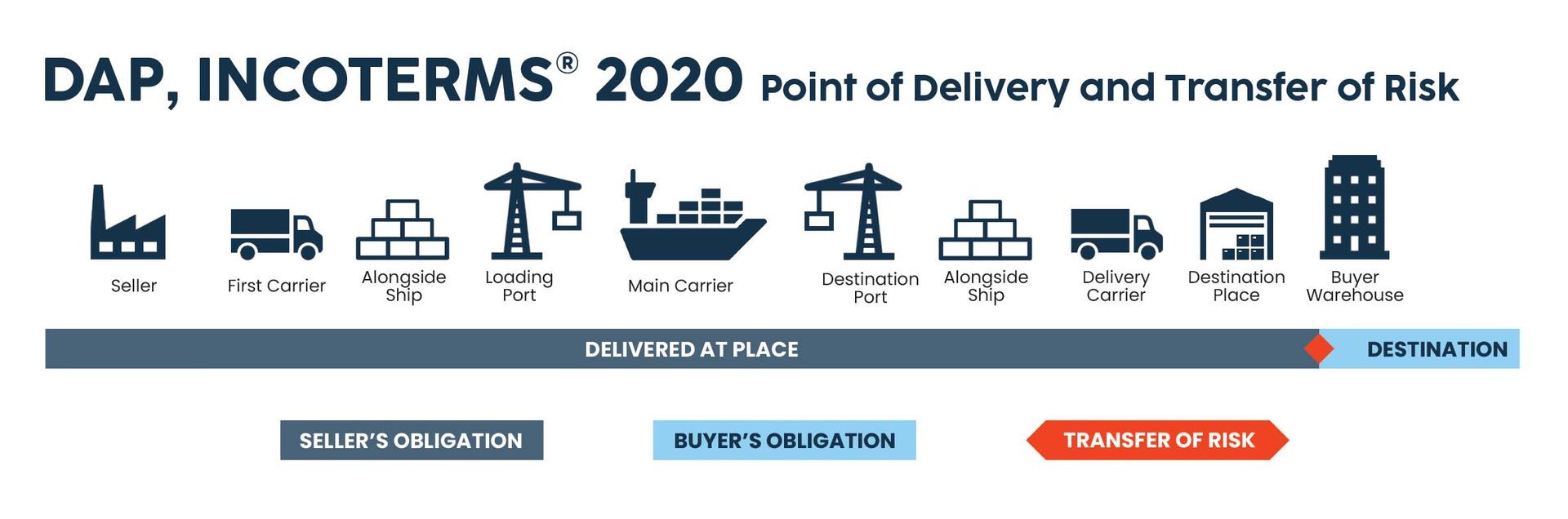
DAP (Delivered to Place)
Delivered at Place (DAP) is an incoterm that requires the seller to deliver the goods to a specified location, with the buyer assuming the risk and cost of unloading. According to DAP, the seller is responsible for all costs and risks related to the transportation of the goods to the agreed location, except for import customs clearance and related costs.
In more detail, DAP means:
-
- The seller must organize and pay for transportation and insurance and bear all risks related to the delivery of the goods to the specified location.
-
- Kupec je odgovoren za raztovarjanje blaga, carinjenje in vse stroške, povezane z uvozom, vključno z davki in dajatvami.
-
- The risk of loss or damage passes from the seller to the buyer when the goods are made available to the buyer at the agreed location.
When to use DAP parity?
In practice, DAP parity is used when:
-
- the supplier can provide us with better delivery conditions than we can provide ourselves.
-
- the supplier informs us that he does not have an agent in our area to carry out the customs clearance process for him, so it is better if we do it ourselves.
-
- we trust the supplier to the extent that the shipment really contains what we ordered, because even in this case we assume the risk regarding customs clearance. However, compared to EXW parity, there is a much smaller risk that we would not actually get what we paid for, because before taking over we have the opportunity to quickly inspect and count the goods and mark on the acceptance sheet if there are any deficiencies (this is then also grounds for objection on marketplaces such as Alibaba, insofar as the sender avoids responsibility).
In practice, the DAP parity is used less and less, because to the extent that foreign suppliers organize transport, they use their connections and cheaper countries (e.g. Hungary) to import into the EU, clear customs there and then deliver it to the final address.
DAP parity is used more often in dealings with suppliers who do not do business with the EU, but have experience with transport (e.g. they send all goods to the USA) and on this account have more favorable conditions than we have.

DDP (Delivered Duty Paid)
Delivered Duty Paid (DDP) is an incoterm that imposes the greatest responsibility on the seller and is considered the "holy grail" of European buyers when doing business with China. Under the DDP, the seller is responsible for all costs and risks associated with the delivery of the goods to the buyer's location, including import clearance, taxes and duties. It is the buyer's sole responsibility to unload the goods at the specified destination.
In more detail, DDP means:
-
- Seller shall arrange and pay for transportation, insurance, export clearance and all other related costs, including import clearance, taxes and duties.
-
- The seller bears all the risks during transportation, and the risk passes to the buyer when the goods are ready for unloading at the agreed location.
-
- The buyer is responsible for unloading the goods at the specified destination.
-
- The price you paid to the seller with DDP parity must be the final price, if there are additional costs for transport, customs or something else, they must be covered by the sender.
When to use DDP parity?
-
- DDP parity advises all "newbies" who are ordering from a single supplier for the first time or those who have no experience with customs and just want the products to arrive at their address without complications as soon as possible, and are ready to pay a little more for it.
-
- this parity is also chosen by those who do not yet have agreements/terms with delivery services in Slovenia and do not want to waste time negotiating and waiting for an offer.
-
- DDP is also suitable for those who start selling products that they do not know very well and do not even know exactly which documentation is required for them. In practice, suppliers often claim that it is not necessary to attach anything, but later during the customs inspection it turns out that additional documentation is required, and unfortunately many suppliers then take advantage of the situation in such a way that they charge the trader a hefty fee for this additional documentation, because they are aware that without it, he can no longer get the goods across and will do anything to receive them.
Despite the fact that DDP is the most expensive parity and works as "hassle-free", recently problems have also appeared with this parity, which we will write about at the end of the article, after the presentation of the last common parity:
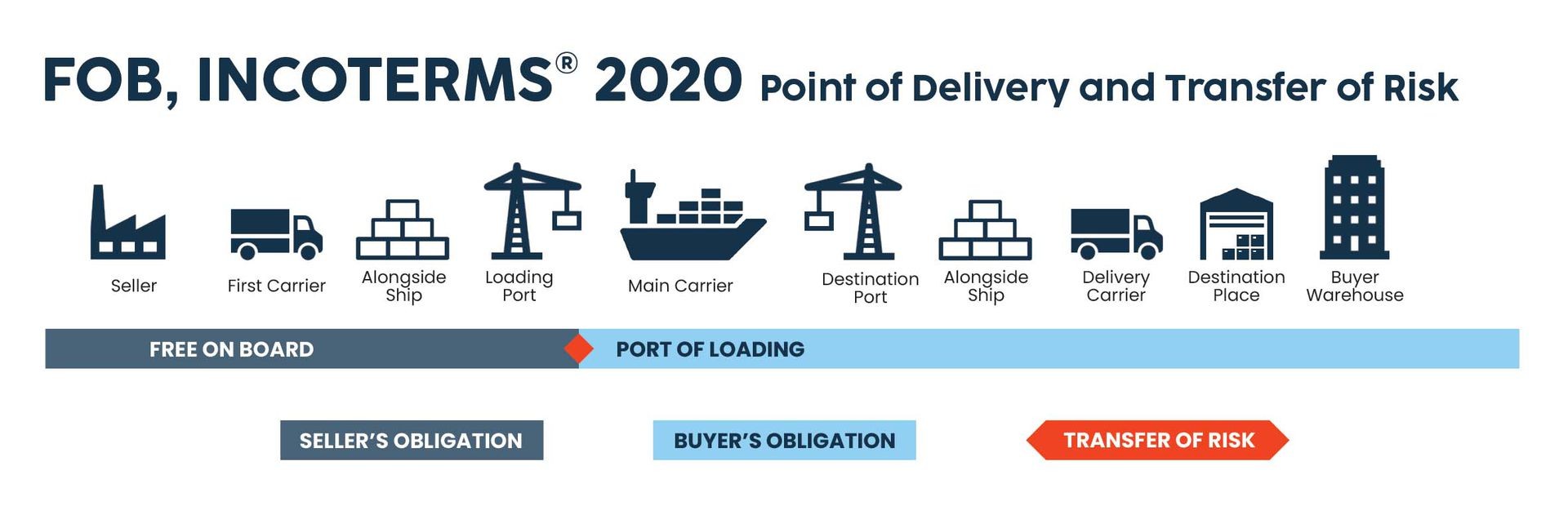
FOB (Free on Board)
Free on Board (FOB) is an incoterm used only for transport by sea and inland waterways. Under FOB, the seller is responsible for delivering the goods on board the vessel of the buyer's choice, and the buyer is responsible for all costs and risks associated with the carriage of the goods from that point forward.
In more detail, FOB means:
-
- The seller must deliver the goods on board the vessel designated by the buyer at the agreed port of shipment.
-
- The seller is responsible for export customs clearance and all costs until the goods are loaded onto the vessel.
-
- The buyer is responsible for all costs, risks and insurance from the time the goods are loaded onto the vessel, including transport and import customs clearance.
When to use FOB parity?
-
- If you have chosen shipping as the type of delivery of your products, you will often find yourself in a situation where you will get a favorable Slovenian transport provider, but only from the Chinese port to the port of Koper. This poses a problem if your supplier is located on the continent, as it is then necessary to bring the goods to the port, and your Slovenian supplier does not deal with this.
-
- It is a parity similar to DAP, except that it is used for shipping, as the supplier will arrange export customs clearance for you and transport the products (usually very cheaply) to the port and load them onto the ship.
-
- If the shipper can be trusted to the point that the products will be ready on time and will not be late on the ship - your shipping agent will tell you the latest date that the products must be loaded, usually a week or so before the ship leaves. We advise you to avoid loading on the last day in agreement with the supplier to avoid the unpleasant situation of your goods not being loaded on time.
-
- If you have also arranged delivery from Koper to your address with a Slovenian provider, or you will be able to do it yourself.

A hidden problem with DDP that no one mentioned to you
Chinese suppliers got used to the fact that DDP parity is chosen mainly by less experienced traders, so they developed an option where they charge you for DDP parity, but they don't actually do it and make a 100% profit.
How is that possible?
To be honest, even those who control the customs clearance of goods do not know this exactly, but after a couple of events that happened to our customers and once to ourselves, we came to the following conclusion:
-
- Larger and more resourceful suppliers have "their people" in a couple of places in Europe, who, despite their large volume and weight, let their shipments into the EU area without customs clearance.
-
- We noticed that these shipments most often came via Hungary, where they were apparently "changed" right after the plane landed from China in such a way that the wrong sender and the wrong place of dispatch (Hungary) were on them. This was probably arranged just before arriving at customs, where such a shipment was then allowed through without customs clearance, as it acted as if it was a Hungarian shipment. Of course, there is also the possibility that this was done by the person who was in charge of customs clearance.
-
- Such shipments are then delivered to the recipient without any customs documentation (despite the fact that the recipient pays DDP parity) and they don't care when asked about the documentation and defend that it was only agreed that the shipment would be delivered to the final location without additional costs - and they are not in charge of how it will be done. Unfortunately, the Chinese often do not understand that the merchant is then in trouble, because he cannot prove the origin of the goods, he cannot claim the cost of the goods, he has problems with inventory management, and he would literally have to "sell the goods on black market" to hide its origin.
How can we avoid this?
Before confirming DDP parity, you must give clear instructions to the sender - that you will require a customs declaration upon receipt of the goods and that the goods must be cleared in the EU. Do not fall for the tricks that "all the papers they can get will be attached" or that "the customs declaration is not necessary in this case", because the suppliers mostly only look at themselves - they do not know your problems and are sometimes even proud of being able to transport the goods without needed documents, but they are not aware of the consequences.
It is highly recommended for those who do business through Alibaba that this is also explicitly written in the order and is later visible in a possible dispute, that the sender has undertaken to send a copy of the EU customs declaration.
This is exactly what happened to me, what can I do?
Get help, you can also contact experts at Warehouse.si and describe to them what kind of problem you have. Do not sell the goods, as you will have to send them for "extraordinary customs clearance" - fortunately, it is often enough to send only 1 item of the whole stock, so that you do not send all the pallets, especially if there are a lot of them. However, this will be an additional cost for you and the question is whether you can claim it later from the sender - depending on your agreement and the order method - we can review this together with you.
So, to conclude - if everything seems too complicated to you and you don't have your own people in China whom you can trust enough to at least check the sent products, we advise you to at least initially contact Slovenian experts, e.g. fulfillment center Warehouse.si, ki lahko v vašem imenu poiščejo izdelke na Kitajskem trgu, jih transportirajo, uvozijo in dostavijo na vaš prag. Pa še bolj ugodne izdelke in transport boste dobili preko njih, ker imajo seveda boljše pogoje.
Seveda morate upoštevati, da je to možno le pri večjih naročilih. It's not just a coincidence that many new online retailers say that they saved so much on delivery and products themselves because of importing products through Warehouse.si that they covered the entire cost of this additional service!
Damir Vidan, CEO
OnlySales.si
Appreciation to my father who informed me on the topic of this web site, this website is really amazing.