In conversations with our clients — particularly entrepreneurs who are just starting an online retail business — we often discover how little is understood about the delivery terms, or Incoterms, that should be agreed before importing goods from a supplier.
That lack of understanding can lead to unexpected costs, problems for the importer and disputes over damaged goods, especially when a retailer simply lets the supplier choose the terms without understanding the consequences. The risk is particularly high when you are importing from China for the first time and do not know the suppliers you have found on Alibaba, AliExpress or similar platforms.
In this guide, we'll use practical examples to explain four common Incoterms used for imports by air or sea.
At the end, we will also discuss a less obvious problem that is rarely talked about but that we have seen affect a growing number of Slovenian businesses importing from China. For some, it can put the business at risk before the products have even gone on sale.
What are Incoterms and delivery terms?
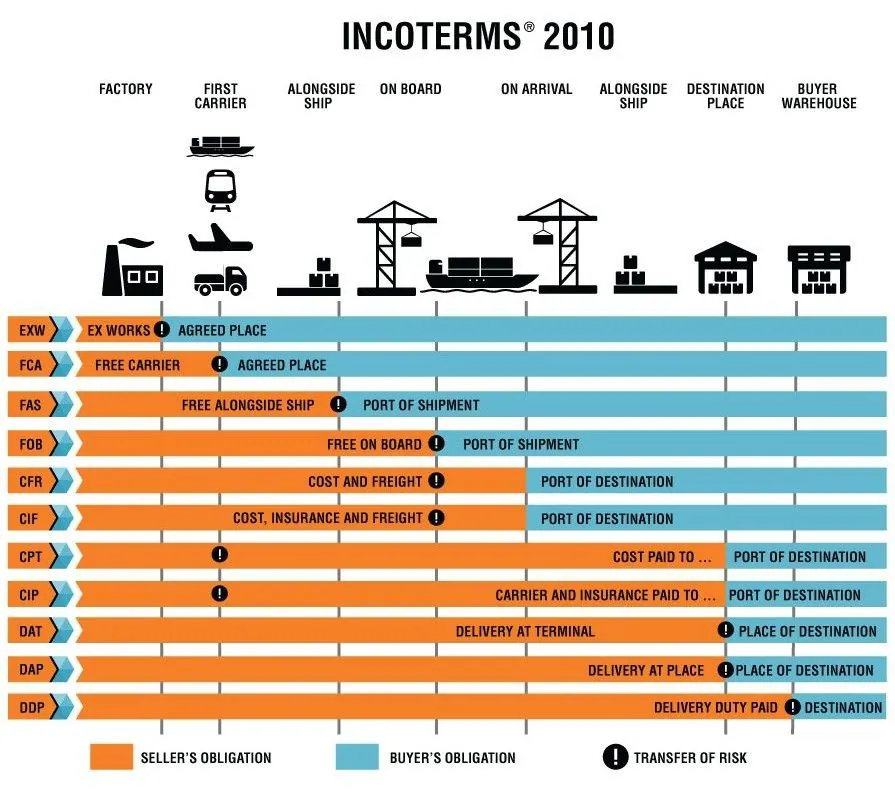
The illustration above is intended as a visual guide to the responsibilities attached to each Incoterm. In simple terms, EXW may give you the lowest supplier quotation, but you then have to arrange collection at the factory, transport, customs clearance and final delivery to your address in Slovenia. If something goes wrong along the way, you may also find yourself trying to establish which of several parties is responsible.
At the other extreme, DDP normally produces the highest all-in price quoted by the supplier. The seller undertakes to arrange and pay for transport, import duties and other applicable charges, and delivery to the agreed destination. The expectation is therefore that the sum you pay is the final amount under the agreed terms. But there is a serious practical risk with some DDP arrangements, particularly those offered by certain Chinese suppliers; we will return to it at the end.
Incoterms — short for International Commercial Terms — are internationally recognised trade terms published by the International Chamber of Commerce (ICC). They define how buyers and sellers allocate costs, risks and responsibilities in international transactions. They are designed to prevent disputes by making the handover points and obligations clearer. We will focus on four of them: EXW, DAP, DDP and FOB.
EXW delivery terms
EXW — Ex Works
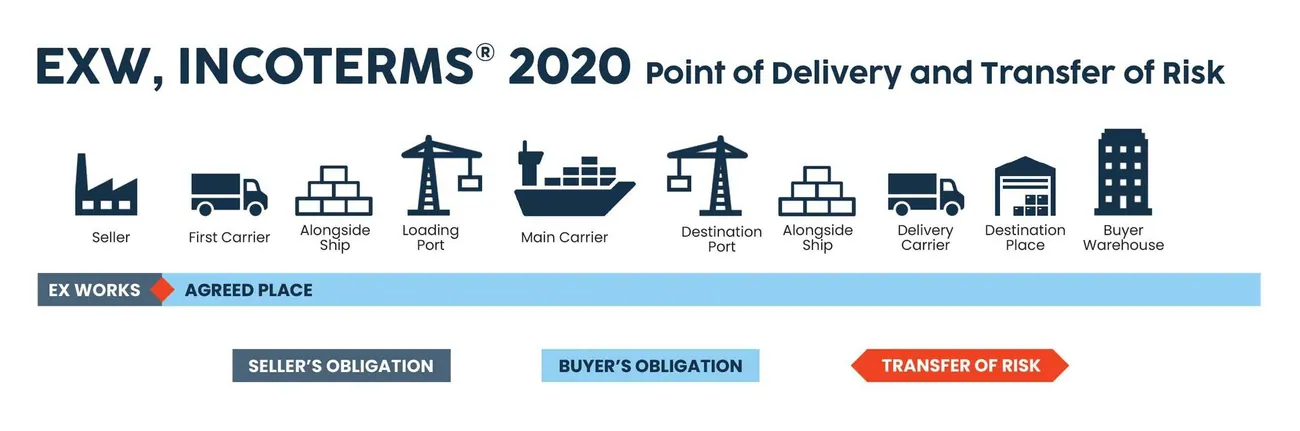
Ex Works places the least responsibility on the seller. The seller must make the goods available at its premises or another named location. The buyer is responsible for arranging and paying for the subsequent movement of the goods, including loading where applicable, transport, customs formalities, insurance and delivery to the final destination.
More specifically, EXW means:
- The seller prepares the goods for collection and informs the buyer when they are ready.
- The buyer arranges and pays for collection, loading and the related transport costs.
- The buyer carries the transport risks from the contractual handover point and is responsible for obtaining the required permits, licences and export/import documentation, subject to the actual contract and applicable law.
When should you use EXW?
In practice, we usually consider EXW when:
- We know and trust the supplier. A long-standing supplier is less likely to send the wrong products, short-ship the order or hand over damaged goods. With EXW, proving who caused damage can be especially difficult: the carrier may blame the factory while the factory insists that the goods were damaged in transit. Without evidence, you may end up bearing the loss yourself. There have even been cases involving major Slovenian retailers where an unfamiliar supplier packed substandard or damaged items into an order.
- Our own EXW transport price is substantially better than the supplier's offer and the saving justifies accepting the additional responsibility. How big a saving is enough depends on the value of the shipment, the amount of work involved and your tolerance for risk. Put a value on your time as well as the potential loss.
- We have compared EXW with DAP and DDP before committing. Find out whether it is better to organise the shipment through a Slovenian agent, such as DHL Slovenia, or let the supplier arrange it through a Chinese carrier or agent. The price differences can be tiny — or surprisingly large.
Generally more suitable for experienced importers
- We understand customs clearance. You should have the required product documents and at least a reasonable estimate of transport, import clearance and additional fees. Often a carrier such as DHL Slovenia handles the customs process on your behalf while you provide the commercial invoice, proof of payment and any product-specific documents, and supply the necessary information before the shipment reaches customs.
- We have a reliable transport contact as well as a reliable supplier. Knowing who to contact at both ends makes it easier to resolve disputes or seek compensation. Common problems include receiving fewer items than were paid for, discovering that the actual volume or weight differs from the supplier's quotation, or finding the shipment damaged during transport.
DAP delivery terms
DAP — Delivered at Place
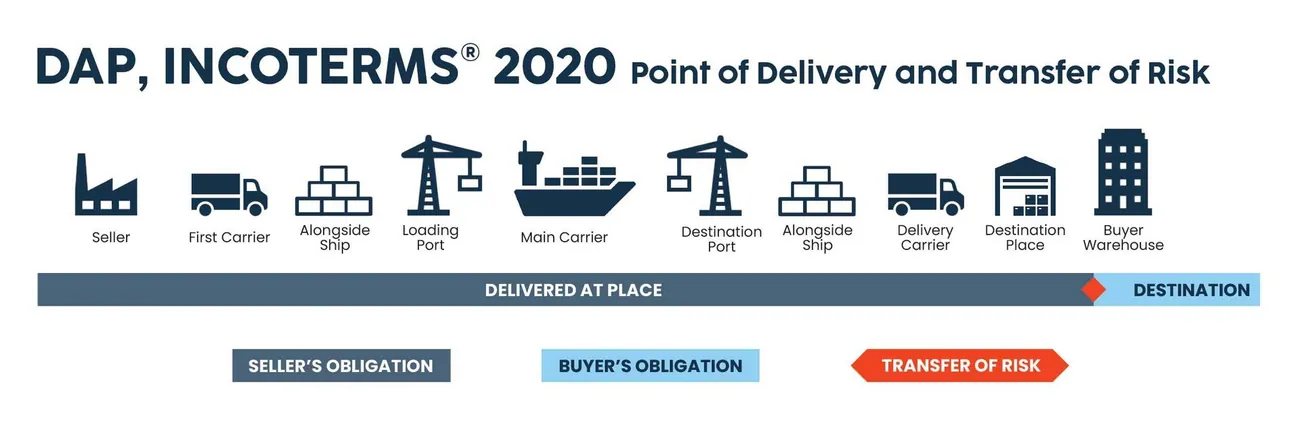
With Delivered at Place (DAP), the seller arranges delivery to a named destination and bears the costs and risks involved up to the agreed handover there. The buyer is responsible for unloading and normally handles the import customs formalities and associated charges.
In more detail, DAP means:
- The seller arranges and pays for transport and bears the delivery risks up to the named destination. Insurance should be discussed separately because DAP itself does not automatically impose an insurance obligation.
- The buyer is responsible for unloading, import customs clearance and import-related costs, including the applicable duties and taxes.
- The risk of loss or damage passes to the buyer when the goods are placed at the buyer's disposal at the named destination, ready for unloading.
When should you use DAP?
In practice, DAP can be appropriate when:
- The supplier can offer better delivery terms than you can obtain through your own freight providers.
- The supplier explains that it has no agent in your destination market to complete import clearance, so arranging that step locally is easier.
- You trust the supplier to send exactly what was ordered, even though you will still be responsible for import clearance. Compared with EXW, DAP reduces some transport-stage exposure because the seller remains responsible for getting the goods to the named place. You may be able to inspect and count the delivery upon receipt and record any discrepancies on the delivery note. That record can help if you later need to raise a dispute through a marketplace such as Alibaba.
In our work, we have seen DAP used less often where overseas suppliers offer end-to-end transport arrangements. Some suppliers use their own freight networks and import goods into the EU through a lower-cost entry point, for example Hungary, before moving the goods onward to their final destination.
We have also used DAP with suppliers who do not normally trade with the EU but have extensive shipping experience elsewhere, such as the US, and can therefore obtain favourable transport rates even if they cannot perform EU import clearance.
DDP delivery terms
DDP — Delivered Duty Paid
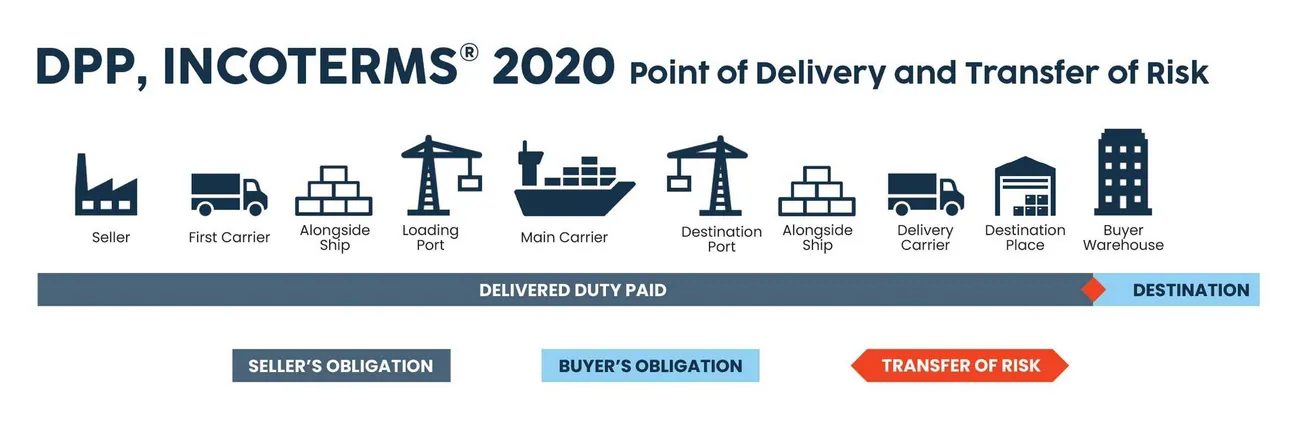
Delivered Duty Paid (DDP) gives the seller the greatest responsibility and is often regarded as the most convenient option for European buyers sourcing goods from China. The seller is responsible for the agreed costs and risks of delivering goods to the buyer's destination, including import clearance and applicable customs duties and taxes. The buyer's responsibility is generally to unload the shipment.
In more detail, DDP means:
- The seller arranges and pays for transport, export formalities and the other agreed charges, including import customs clearance, duties and taxes. If insurance is required, its scope should be agreed explicitly.
- The seller carries the relevant transport risks until the goods arrive at the named destination ready for unloading.
- The buyer is responsible for unloading at the agreed destination.
- The agreed DDP price should cover the seller's obligations under that term. If extra transport or customs charges arise that fall within the seller's DDP responsibilities, the seller — rather than the buyer — should bear them, subject to the contract.
When should you use DDP?
- DDP may appeal to new importers buying from a supplier for the first time, or to businesses with little customs experience that simply want products delivered with minimal administrative burden and are willing to pay more for that convenience.
- It may also appeal to importers who do not yet have transport contracts or negotiated carrier rates and do not want to spend time asking for quotations or organising freight.
- DDP can seem attractive if you are importing an unfamiliar type of product and do not know exactly which certificates or documents will be required. Suppliers may initially claim that nothing special is needed, only for customs to request additional documentation. We have seen situations where a supplier then charged the buyer heavily for the missing papers, knowing the buyer could not get the shipment released without them. An all-inclusive arrangement is appealing — but it does not remove the need to check product compliance.
Although DDP is usually the most expensive option and appears hassle-free, we have also encountered problems with it. We will explain those after covering the last of our four commonly used Incoterms.
FOB delivery terms
FOB — Free on Board
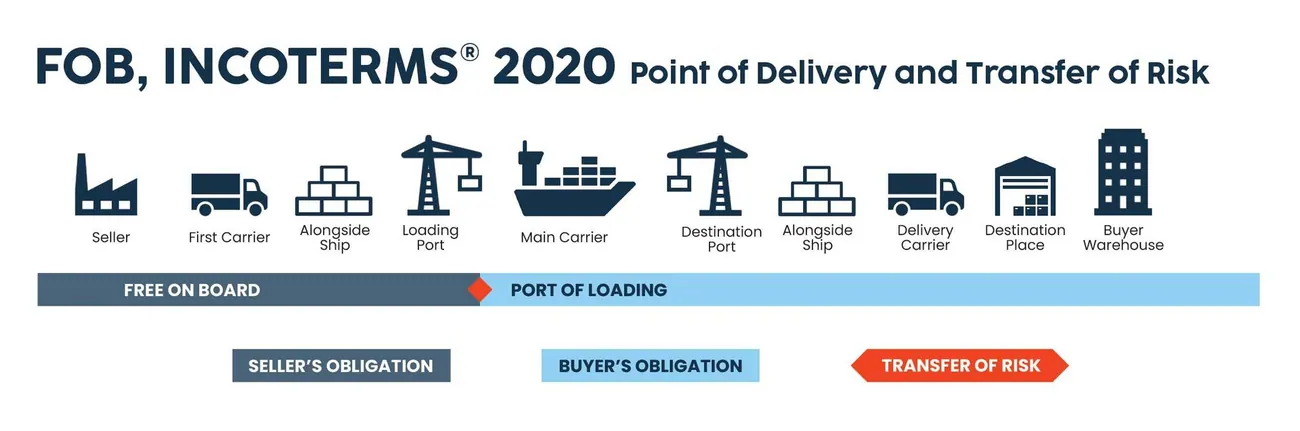
Free on Board (FOB) applies only to sea and inland waterway transport. The seller is responsible for placing the goods on board the vessel nominated by the buyer at the agreed port. Once the goods are on board, the buyer bears the subsequent transport risks and costs.
In more detail, FOB means:
- The seller delivers the goods onto the nominated vessel at the agreed port of shipment.
- The seller arranges export clearance and pays the costs incurred up to the agreed on-board delivery point.
- The buyer bears the transport risks and costs from the moment the goods are on board, including the sea voyage, any insurance the buyer chooses to arrange and import customs formalities.
When should you use FOB?
- If you choose sea freight, you may find an attractively priced Slovenian freight forwarder whose quote covers the journey from a Chinese port to the Port of Koper. That creates a problem if your supplier is located inland: someone still has to move the goods from the factory to the port, and your Slovenian forwarder may not handle that leg.
- FOB can solve that problem. It resembles the idea of DAP in that the seller organises the initial transport, but it is designed for sea freight. The supplier handles export clearance, delivers the products to the agreed port — often inexpensively — and loads them onto the ship.
- You must trust the supplier to have the goods ready on time. Your sea-freight agent will give you a cut-off date for loading, often around a week before the vessel's scheduled departure. Avoid planning factory dispatch for the very last possible day, or you may find your shipment misses the vessel.
- You must also have an arrangement for delivery from the Port of Koper to your warehouse, either through the Slovenian logistics provider or using your own transport.

A problem with DDP
The hidden DDP problem nobody warned you about
Some Chinese suppliers have realised that DDP is often chosen by inexperienced buyers. In the cases described below, a supplier charged for what appeared to be a full DDP service, but the goods entered the EU without the import-clearance documentation that the buyer needed. That can leave the seller with a price advantage at the buyer's expense.
How can that happen?
To be completely candid, the exact route through which certain shipments avoid proper controls can be difficult to establish even for the people responsible for checking them. After several incidents affecting our clients — and once our own business — we drew the following conclusions from the information available to us:
- Some larger, more resourceful suppliers appear to have contacts at certain points in Europe that allow shipments to enter EU distribution networks despite their significant volume and weight, without the importer receiving evidence of proper customs clearance.
- In the cases we investigated, a number of shipments seemed to have passed through Hungary. Following arrival by air from China, the documentation appeared to be altered to show a different sender and an origin in Hungary, making the shipment look as though it were moving domestically or within the EU. We cannot say exactly who made those changes or at which stage; the possibility of improper handling during the customs process could not be excluded.
- These shipments were then delivered to the recipient without any usable customs documentation, even though the buyer had paid for DDP. When asked for the declaration, the sender sometimes dismissed the request, arguing that its only obligation was to deliver the goods without additional charges and that the route was its own business. But this can cause serious problems for the retailer: proving how the goods entered the EU, documenting the stock and its cost, maintaining accurate accounts and demonstrating lawful product provenance may become difficult. You should never be put in a position where selling those goods would mean concealing their true origin.
How can you avoid this situation?
Before approving a DDP order, give the sender clear written instructions: you will require the appropriate EU customs declaration and evidence of lawful import clearance. Do not accept vague promises such as “we'll include whatever papers we can get” or “a customs declaration isn't needed for this shipment” without obtaining a satisfactory explanation. Suppliers may focus on their own shipping costs without understanding the buyer's documentation obligations.
If you buy through Alibaba, we strongly recommend recording these requirements explicitly in the order itself so that, if a dispute arises, there is written proof that the supplier agreed to provide a copy of the relevant EU import customs documentation.
This has already happened to me. What should I do?
Seek specialist help. You can explain your situation to the experts at Warehouse.si. Do not put undocumented stock on sale before the import position is resolved. You may need to arrange a corrective customs procedure. Depending on the goods and the authorities' instructions, a representative sample may sometimes be sufficient for inspection instead of moving entire pallets. It will create additional costs, and whether you can recover those from the supplier depends on the contract, the ordering method and the circumstances.
If the process sounds overwhelming and you do not have trusted people in China who can at least inspect what has been packed, consider asking a Slovenian sourcing and logistics specialist for help, particularly with your first orders. A company such as Warehouse.si may be able to find products, arrange transport and imports and deliver them to your premises. Better purchasing and freight terms can sometimes make the additional service worthwhile.
Of course, this is generally more realistic for larger orders. It is no coincidence that some new online retailers tell us that the savings achieved on goods and delivery when importing through a specialist have more than covered the fee charged for that additional service.
Damir Vidan
CEO, OnlySales.si
For current customs requirements, consult the Slovenian Financial Administration (FURS import guidance) and the official EU guidance on product compliance.